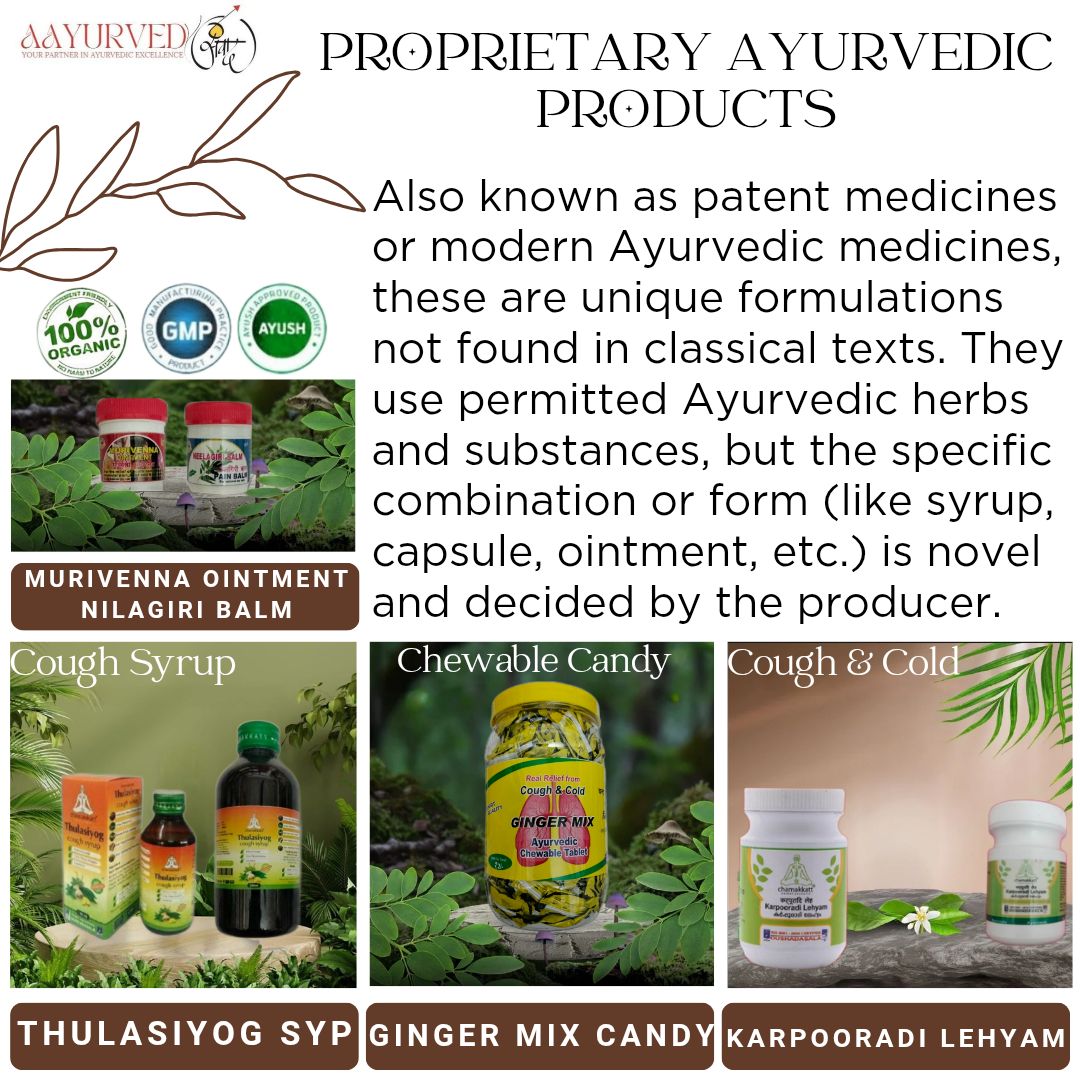
Definition
- Proprietary Ayurvedic Products: Also known as patent medicines or modern Ayurvedic medicines, these are unique formulations not found in classical texts. They use permitted Ayurvedic herbs and substances, but the specific combination or form (like syrup, capsule, ointment, etc.) is novel and decided by the producer.
Objective
- Innovation & Modernization: Create new therapies or user-friendly dosage forms to address emerging modern health needs, lifestyle disorders, and global consumer demand for Ayurveda.
- Expand Treatment Spectrum: To cover areas where classical formulations may not fully address specific diseases or practical needs.
- Ease of Use: Improved palatability, convenience (tablets, capsules, syrups), and enhanced patient compliance compared to traditional products.
Purpose & Role in Ayurvedic Practice
- Therapeutic Flexibility: Physicians can prescribe preparations tailored for specific clinical situations, patient groups, or combinations of symptoms.
- Evidence-Based Practice: Manufacturers often conduct research and clinical trials to validate safety and efficacy; this helps build scientific credibility for Ayurveda in mainstream and export markets.
- Quality Control: Proprietary products typically use fewer, well-sourced ingredients, ensuring consistency and reliability.
- Business Growth: Support brand development, market differentiation, and higher profit margins for producers, distributors, and retailers.
Examples in Practice
- Proprietary products may include herbal liver protectives (e.g., Liv 52), immunity boosters, pain relief balms, stress management capsules, and customized skin-care formulations, among others.
- They are regulated under India’s Drugs & Cosmetics Act, requiring licenses from State and Central authorities—and often are subject to higher safety, stability, and clinical standards.
Summary Table
|
Aspect |
Classical Ayurvedic Product |
Proprietary Ayurvedic Product |
|
Formula Source |
Ancient texts |
Manufacturer innovation |
|
Ingredient Mix |
Often many, sometimes rare |
Select, more accessible |
|
Dosage Forms |
Traditional (churna, vati, etc) |
Modern (capsule, syrup, balm, etc.) |
|
Use |
Traditional therapies |
Modern ailments, user convenience |
|
Objective |
Preserve tradition |
Innovate, solve new problems |
|
Role in Practice |
Holistic, dosha balancing |
Evidence-based, targeted therapy |
|
Regulatory Requirement |
Text-based, permitted herbs |
Trials, research, licensing |
Conclusion
Proprietary Ayurvedic products offer a bridge between classical Ayurvedic wisdom and contemporary needs, enabling practitioners and businesses to drive innovation, reach new patients, and expand the scope of holistic healing—while supporting global growth and scientific validation for Ayurveda